




Dating as a Jewish single is a specific search problem, and the specifics are arithmetic before they are anything else. You are not looking for just anyone. You are looking for someone whose background overlaps with yours closely enough that the important conversations can start from a shared assumption instead of starting from an explanation.
What follows is about how that search behaves online: what the size of the community means in practice, how to write a profile so the right people recognise you, and what the tools on Kismia actually do. No promises about outcomes. Mechanics and a few numbers.
What the numbers say about the pool
Around 7.5 million people in the United States are Jewish, roughly 2% of the population, according to the Pew Research Center study of Jewish Americans. Two per cent is a small share. That single figure explains most of what people find frustrating here, and it is a much better explanation than anything about their own profile or their own luck.
Work it through for a town of 100,000 residents. Two per cent is 2,000 people of all ages, and once you set aside children, couples and everyone outside your age range, what is left is a group you could probably list by name. Large cities give you a bigger number and a different version of the same problem, because the community there tends to be spread across districts that rarely overlap.
The other useful thing in the Pew data is how much variation sits behind one word. Some respondents describe a life organised around community and observance; others were raised in a Jewish family and now mark two or three holidays a year. Both are accurate uses of the word. Neither one tells you what the other person is looking for in a partner, which is precisely why a label works badly as a search term.
Why is using online dating apps a good choice?
Mostly because of the arithmetic above. An offline circle of a few dozen acquaintances refreshes slowly, and the introductions that used to arrive through family or friends usually slow to a couple a year once everyone is past thirty. Online you are looking at a pool that is not limited to the people you can physically run into this month, which matters far more for a small community than for a large one.
The second reason is time. You can look through profiles on a Tuesday evening from the sofa, in twenty minutes, without organising a whole evening around a maybe. Signing up, filling in a profile and browsing cost nothing here, so the first look is a question of attention rather than money.
The third is distance. If nobody suitable lives within twenty minutes of you, an online search lets you decide for yourself how far you are willing to travel, instead of having that decided by whoever happens to live nearby. Long distances are hard work. They are still an option, and offline they often are not.
Looking for common interests and like-minded people is a good start!
It is a good start because it is answerable, while "same background" usually is not. Two people can both write one word about their heritage and live completely different weeks. What actually predicts whether you get along is narrower: how often you take part in community life, how you mark the holidays, how you talk about family plans, and whether you want a partner from the same background or someone who simply respects it.
Interests do a similar job from the other direction. They are worth filling in properly, since they carry weight on the completion bar and they give the other person something concrete to reply to. A shared taste in hiking or in bad television is a smaller thing than shared values, and it starts more conversations.
What should your profile look like?
Detailed, and specific rather than declarative. On Kismia the completion bar fills in blocks, and the weights are worth knowing: three photos are worth 25%, the "About me" section 20% and interests another 20%. Text carries as much as pictures. Most people do the opposite, with five photos and an empty description.
Compare two descriptions. "Jewish, family-oriented" could be half the site. "I grew up in a fairly traditional family, I help run a community youth group on Sundays and I would like children eventually" describes one person, and it filters honestly in both directions. Anyone put off by the second version was not a match for you in the first place.
You decide what goes into that text, and it is worth being deliberate about the level of detail. There is no field on Kismia asking how observant you are, and no filter that sorts members by faith. That is a real limitation and it is the reason the description matters more here than it would on a general search: your own words are the only place this part of your life is visible.
Two smaller mechanics help. The goal field takes one tap and prevents a familiar kind of misunderstanding, with four options to pick from: a long-term relationship, starting a family, conversation and friendship, or not sure yet. And there are 16 ready-made icebreaker questions for the evenings when the blank message box wins. Picking one is easier than composing something from nothing.
How the search works on Kismia
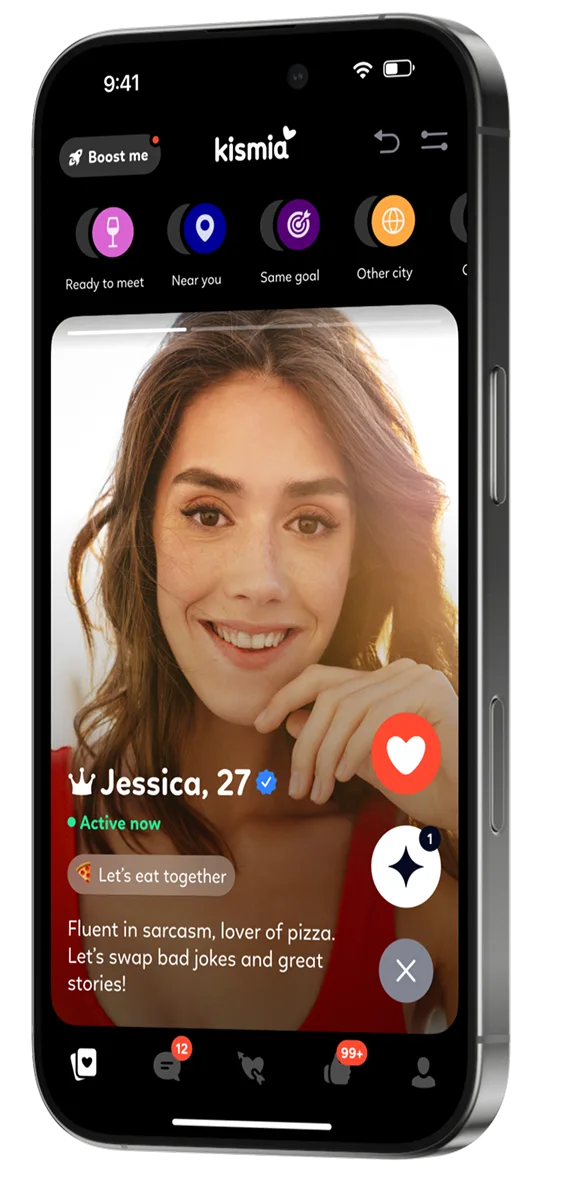
Discover is a card feed: swipe, or tap the heart. Two settings there are free, gender and age, which is usually enough for a first look at who is around you. Narrowing further happens in search, where the full filter panel covers city, online status and verified profiles, and that panel is part of Premium. The Nearby tab, included in Premium GOLD, shows who is close right now.
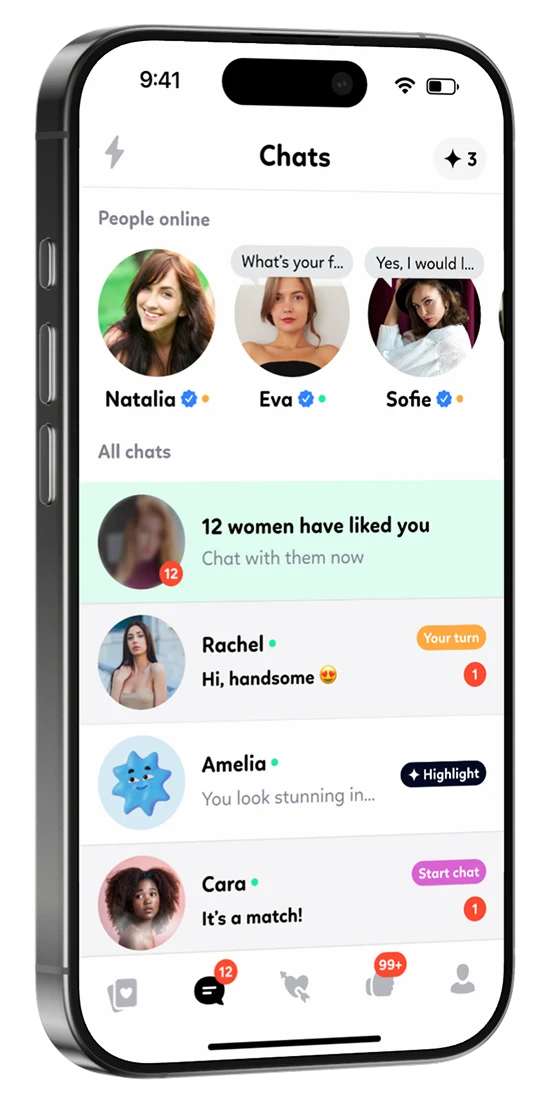
Messaging works on a limit, with two exceptions worth knowing. You can write to any Premium member for free, and they are marked by a green crown beside the photo. You can also reply to anyone who contacts you first, so an incoming message does not sit behind a paywall.
On safety the useful parts are ordinary ones. Photo verification is optional, and once someone completes it the small grey tick beside the name turns blue, which tells you something about that person and nothing about the rest of the database. Reporting and blocking work against any account at any moment. Registration is for adults only, 18 and over, and the usual caution applies: your home address, your workplace and your financial details can wait until you have a reason to trust someone.
One note on the category itself. Jewish dating sites split into two kinds: niche services organised around a single community, and general platforms where background is something members describe in their own words. Kismia belongs to the second kind, which means a larger pool and more weight on how you write about yourself. If your search is shaped by faith in a different community, the way people approach Muslim dating follows much the same logic, and if it is shaped by a line of work instead, the same is true of dating someone in uniform.
Conclusion
Nothing here is complicated, and none of it is quick. A community of two per cent means a smaller pool, so the search rewards patience and a description that says something true about your week rather than a list of adjectives that would fit anybody. Write the specific version of your background instead of the label. Set gender and age, look at who is actually around, and let the conversation do the rest of the work.