




Most of what gets written about dating black men is somebody's account of how it went. Those pieces are worth reading, and they answer a question you probably aren't asking yet. If you haven't sent a first message, how it went for someone else is not the thing standing in your way.
This page takes the earlier questions. How many single black men there are and where they live. How replies get distributed on dating platforms, and why that tends to matter more than your photos. How to tell, four messages in, whether someone is interested in you or in an idea of you. And what you can actually narrow a search by once you're on Kismia.
How Many Single Black Men Are There, and Where
Start with the size of the group, because most writing on the subject implies something narrower than the numbers describe.

More than half of Black men in the United States have never married. The figure was 51.4% in 2020, against 47.5% of Black women. Never married is not the same as unattached, and none of it tells you who is currently looking. It does place the question, though. Whatever makes this search hard, a shortage of people usually isn't it.
Geography moves the picture more than most people expect. Marriage prevalence among Black adults sat at 31.0% nationally across 2015–2019, down a little from 32.8% a decade earlier, and the spread across states is wide at both ends. Hawaii had the highest share of married Black adults in that period. The District of Columbia had the lowest, which is another way of saying it has the largest share of never-married Black adults in the country.
Read that as description rather than as a route. State-level figures describe whole populations, not the membership of any one service, and they say nothing about who is active on your screen this week. They are useful mainly for calibration: if a city feels thin, that impression is often about the city.
Who Replies to Whom, and What That Changes
When messages go unanswered, the first explanation that comes to mind is usually about you. It rarely is.
Replies on dating platforms follow patterns, and those patterns hold even where you would expect them to break. Education is the clearest case: white daters with a college degree tended to contact and answer white daters without one more readily than black daters who had a degree, according to an analysis of message exchanges on a large dating site. A credential that shifts outcomes almost everywhere else shifted very little here.
That is worth knowing before you read anything into a quiet inbox. For anyone dating black men, much of what looks like a personal verdict is the shape of the pool being searched, and no photo fixes a pool.
The part that stays in your hands is the opening line. A first message tied to something specific gives the other person a place to start: a sentence from his About me, or his answer to one of Kismia's 16 icebreaker questions. Generic openers hand that work back to him, and most people set that work down.
Specific is a lower bar than it sounds. It usually means one detail and one question attached to it, not a paragraph. The detail is doing the work, because it proves you read something, and that alone puts a message in a different pile from the rest of the inbox.
Interest in a Person, Interest in a Type
Nearly everything written on this subject names the problem once and moves on. Naming it doesn't help much. What helps is knowing what it looks like in a conversation that is four messages old.
A few things tend to show up early. One is where the questions point: someone interested in you asks about what you put on your profile, and someone interested in a category asks about the category. Another is what a compliment attaches to, a person or a feature standing in for a group. The third is sequence. If race arrives in the conversation before anything you wrote does, that ordering is information by itself.
None of this convicts anybody. People are clumsy early on, and a weak opener is often just a weak opener. The workable move is to answer with something specific from your own side and watch whether the next message follows you or goes back to the category. Two or three exchanges usually settle it.
There is also a floor of unpleasantness on dating platforms, and it has been measured. In a survey of U.S. online daters, 48% said they had run into at least one of the following: unwanted explicit messages, continued contact after saying no, name-calling, or threats. Black users reported unwanted explicit messages at higher rates than white users did. Knowing the base rate makes it easier to treat a bad message as traffic rather than as a signal about you.
If a conversation goes somewhere you don't want it to go, you can block and report from the profile, and the Safety Center covers what happens after that. Some of the same ground, seen from the other side, sits in our online dating for Black women page, and the practical parts of interracial dating advice overlap here more than the labels suggest.
What Actually Narrows the Search
Here is what the tools do. If the plan is to meet black men online rather than wait for a coincidence, this is the part that carries it.
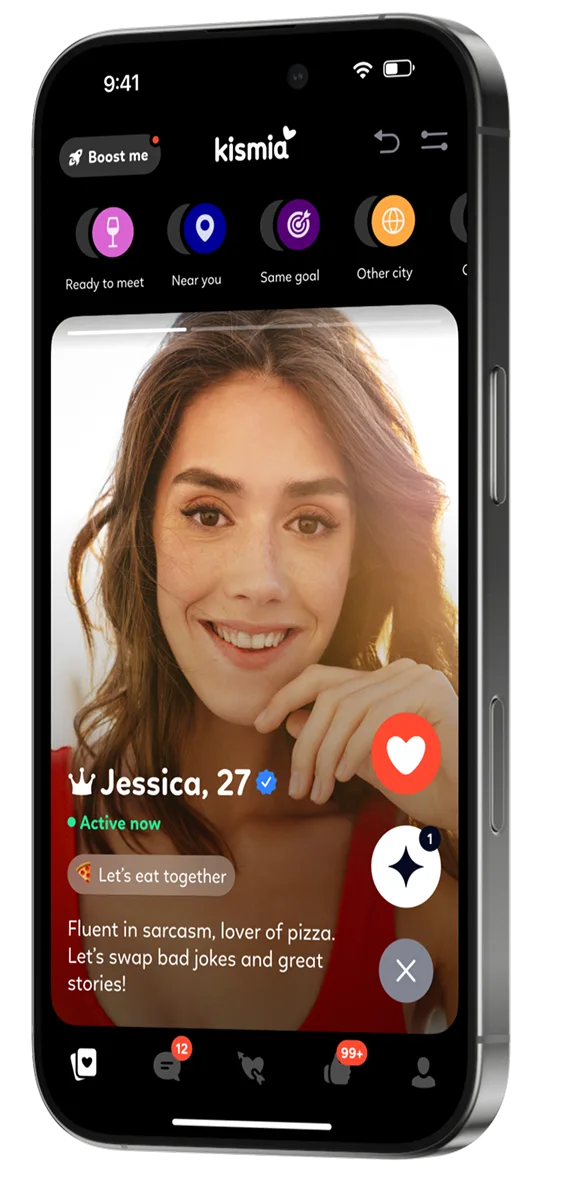
Discover is the swipe feed. Its filters are gender and age, and they're free. That is the whole free filter set, which is worth knowing before you plan a search around anything finer.
Search has two tabs. In All you can see the list of people, while the filter panel — city, gender, age, online status, verification — comes with Premium. Nearby is Premium GOLD, and GOLD also adds filters for dating goals, height, mood and habits. Seeing which city another member is in belongs to GOLD as well.
The Activity section is where the quieter work happens. Suitable is an algorithmic shortlist, and it factors in what you filled into your Education and Career fields, so those aren't decorative. Visitors shows who opened your profile. Matches holds mutual likes. The full list of everyone who liked you is a GOLD feature.
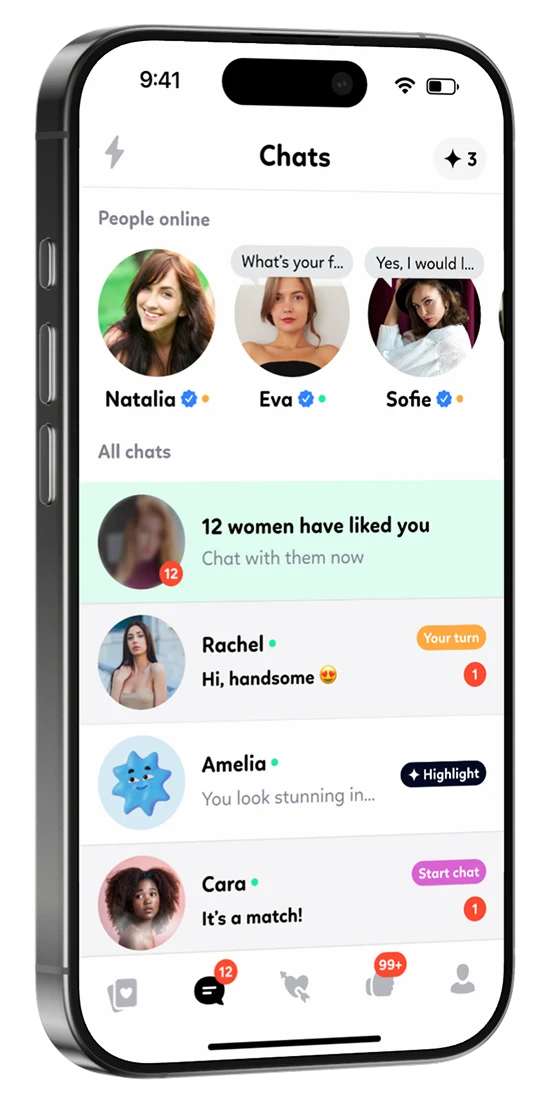
On messaging, the line runs like this. You can reply for free to anyone who writes to you first, and you can chat for free with any Premium member — look for the green crown next to their photo. Beyond that, conversations run through a subscription. Verification is optional: a badge means the person confirmed their photo with a selfie that is never published, and our team reviews profiles manually while automated systems flag suspicious accounts.
Your own profile is scored in steps, and the text counts for more than most people assume. About me is worth 20% of the completion scale and your interests another 20%, so the written half comes to forty. Three photos and the account itself come to the same forty. Primary info, which holds Education and Career, is the remaining twenty, and it is the block Suitable reads.
Creating a profile costs nothing, and three photos with a filled-in About me is enough to start. If you'd rather begin broader than one audience, the dating site for Black people page covers the same tools without the narrower framing.